Author: Dr. James Holloway
Expertise: Report Writing Expert
Published: June 18, 2025
Last Updated: February 02, 2026
The Engineering Lab Report Guide: Formats and Formulas
Category: Engineering | Read Time: 15 Mins
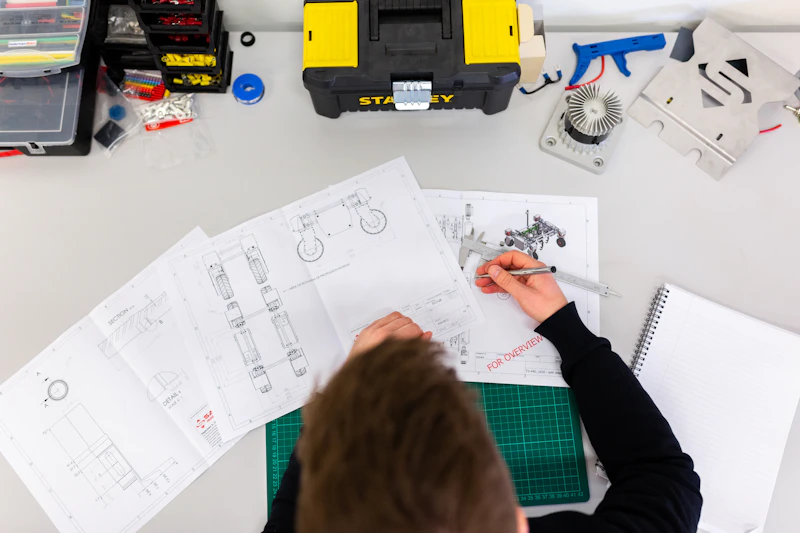
A standard engineering lab report includes: Title Page, Abstract (Summary), Introduction (Theory & Objectives), Apparatus, Methodology (Procedure), Results (Data & Formulas), Discussion (Error Analysis), Conclusion, References, and Appendices.
1. Introduction: Why Lab Reports Matter
In engineering, theoretical calculations mean very little if they cannot be proven in the real world. The lab report is the bridge between textbook mathematics and physical reality.
However, many brilliant engineering students score poorly on their lab reports. Not because their data is wrong, but because their formatting, data presentation, and error analysis are weak. Engineering professors are notoriously strict about significant figures, standardized formatting, and clear graphs. In this guide, we break down exactly how to write a First-Class engineering lab report.
2. Step-by-Step Explanation of the Format
Unlike a humanities essay, an engineering report must follow a rigid structure. Here is exactly what goes into each section:
1. The Abstract (or Summary)
Written last, this 150-250 word section tells the reader the objective, the core method used, and the final numerical results (including error margins). If you measured the gravity constant to be 9.80 m/s² ± 0.02, state it here.
2. Introduction & Theory
Explain why the experiment is being conducted. Introduce the governing physical laws or formulas. For example, if you are doing a fluid mechanics lab, you must introduce Bernoulli's equation here, define all variables, and state your assumptions.
3. Apparatus & Methodology
List the equipment used (often accompanied by a schematic diagram). Describe the procedure in the past passive tense (e.g., "The voltage was measured..." NOT "I measured the voltage..."). Provide enough detail so another engineer could replicate the test.
4. Results (Data & Formulas)
Present your raw and processed data using clear tables and graphs. All formulas used to process data must be clearly typed using an equation editor. Never copy-paste a formula as a blurry image.
5. Discussion (Error Analysis)
This is where you earn your Distinction. Compare your experimental results to the theoretical values. Calculate the percentage error. Most importantly, identify the sources of systematic and random errors, and suggest how the experiment could be improved.
6. Conclusion
A brief summary stating whether the objectives of the experiment were met, driven by your final numerical findings.
3. Examples Students Can Understand
How you format your formulas and data is critical. Look at this comparison:
⌠Bad Formatting (Failing Grade):
The stress was calculated using force over area. Stress = F/A. So 500 / 0.05 = 10000.
Why it fails: No units, no equation formatting, no proper variable definitions, and missing significant figures.
✅ Good Formatting (Distinction Grade):
Normal stress ($\sigma$) is defined as the applied force ($F$) divided by the cross-sectional area ($A$):
Given an applied force of $500 \text{ N}$ and an area of $0.05 \text{ m}^2$:
Why it succeeds: Variables are defined, equations are numbered, standard units (Pa) are used, and scientific notation is applied correctly.
4. Common Mistakes Students Make
- Writing in the First Person: Never write "We poured the water." Write "The water was poured." Engineering reports require an objective, passive voice.
- Mixing Results and Discussion: The Results section is for *what* happened (data, graphs). The Discussion section is for *why* it happened (theory, errors). Don't mix them.
- Ignoring Error Analysis: An experimental value of 100 is useless in engineering unless you state the uncertainty (e.g., 100 ± 2). Always calculate percentage difference from theoretical models.
- Naked Graphs: A graph without labeled axes, units, a descriptive title (Figure 1: ...), and a legend is an automatic fail.
5. Practical Tips for University Assignments
- Number Everything: All equations must have a number flush right, e.g., (Eq. 1). All tables must have a title above them (Table 1: ...). All graphs/figures must have a title below them (Figure 1: ...).
- Appendices for Raw Data: Do not clutter your main report with 5 pages of raw Excel data points. Put the raw data in an Appendix and only put the summarized graph in the "Results" section.
- Significant Figures: Your final result cannot be more precise than your least precise measuring instrument. If your ruler measures to 1mm, do not give a final answer of 14.56783 mm.
6. Useful Academic Tools
Use industry-standard tools to make your report look professional:
- LaTeX / Overleaf: The gold standard for typesetting engineering reports and rendering complex mathematical formulas perfectly.
- MATLAB / Python (Matplotlib): Better than Excel for generating high-quality, precise scientific graphs with error bars and lines of best fit.
- MathType / Word Equation Editor: If you aren't using LaTeX, you must use Word's built-in equation editor (`Alt` + `=`) to format formulas properly.
7. Frequently Asked Questions (FAQs)
1. How long should an engineering lab report be?
Typically between 1,500 and 3,000 words, depending on the complexity of the lab. Always check your module handbook. Precision and conciseness are valued over word count in engineering.
2. Do I use first or third person in a lab report?
Always use the third-person passive voice (e.g., "The sample was heated") to maintain objectivity.
3. How do I format equations in a lab report?
Equations must be centered on the page with a sequential equation number in parentheses flush to the right margin.
4. What is the difference between Results and Discussion?
Results objectively present the data you gathered (tables, graphs, final calculated numbers). Discussion interprets that data, explains anomalies, and compares it to expected theoretical values.
5. Does the abstract count towards the word limit?
In most universities, the abstract, reference list, and appendices do not count towards the total word limit. Check your specific brief to be sure.
✅ The Final Lab Report Checklist
- 🔲 Is my abstract less than 250 words and contains final numerical results?
- 🔲 Are all equations typed cleanly and numbered?
- 🔲 Do all my graphs have labeled axes with units and a descriptive figure caption?
- 🔲 Did I perform a thorough error analysis (Random vs. Systematic errors)?
- 🔲 Is the entire report written in the third-person passive tense?